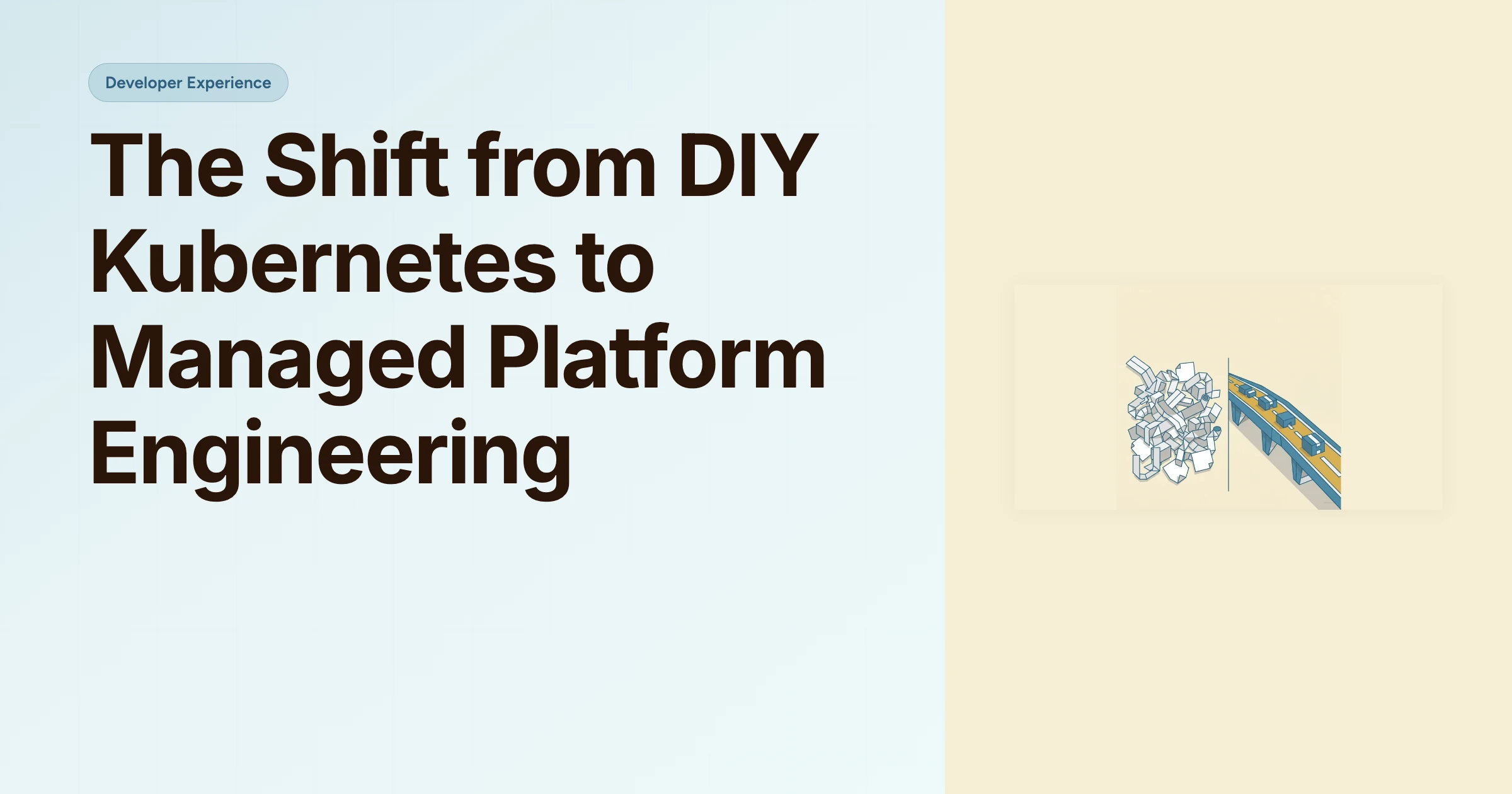

TL;DR
High-growth SaaS organizations frequently encounter catastrophic production outages when their artisanal, do-it-yourself Kubernetes environments collapse under the sheer weight of unmanaged architectural complexity. The transition from managing low-level cluster internals to adopting Managed Platform Engineering (MPE) has become the essential substrate for maintaining digital resilience and accelerating product innovation in 2026.
1. The Day 2 Operations Crisis: When the Enabler Becomes the Bottleneck
The high-stakes operational pain point for modern engineering teams is no longer the initial deployment of a cluster but the crushing weight of sustained Day 2 operations. While the industry has spent the last decade perfecting initial deployment strategies, the reality of maintaining complex homegrown orchestration layers has transformed from an elite capability into organizational inertia. When critical services encounter networking bottlenecks or persistent OOMkill loops, your talent often spends hours troubleshooting CNI plugins or tuning resource limits instead of shipping high-value features.
Infrastructure failures in DIY environments frequently manifest as cascading outages that are difficult to diagnose without a specialized platform layer providing standardized observability across the entire estate. According to the 2025 Stack Overflow Developer Survey, more than one-third of professional developers now rely on AI-enabled tools simply to manage the technical debt inherent in infrastructure.
2. Thesis: The "DIY Kubernetes" Hallucination of Total Control
For much of the cloud-native era, building and maintaining a custom, homegrown Kubernetes stack was viewed as the definitive hallmark of a high-maturity organization. Organizations believed that by owning every component of their orchestration layer, they could achieve a level of optimization and security that managed services simply could not provide.
Kubernetes served as the ultimate tool for this empowerment, offering a standardized API that promised to turn complex infrastructure into a programmable utility. However, this badge of honor often came at the hidden cost of undifferentiated heavy lifting that distracted the engineering team from the core mission of their unique product offerings.
3. Pain Point Analysis: Why Traditional DIY Solutions are Failing
The current industry standard of DIY Kubernetes management is failing due to an unsustainable cognitive load placed upon developers. Developers are no longer just responsible for application logic; they are expected to be experts in Docker, Kubernetes runtime settings, Terraform, and LLM System Design.
| Capability Layer | DIY Kubernetes (Legacy Status Quo) | Managed Platform Engineering (Reclear Standard) |
|---|---|---|
| 1. Developer Interface | Manual kubectl and raw YAML manifests | Self-service Portal with opinionated Golden Paths |
| 2. Security Integration | Per-cluster manual audits and bespoke policies | Automated guardrails and centralized Security-as-Code |
| 3. Scaling Efficiency | High operational toil per individual cluster | Centralized management with standardized API abstractions |
| 4. Cognitive Load | Developers function as part-time SysAdmins | Developers focus exclusively on shipping Product value |
The financial implications of maintaining a DIY infrastructure suggest that the human capital cost is often 3x to 5x higher than the cloud consumption costs. When cognitive load exceeds a developer's capacity, build times increase, and innovation stalls.
4. Synthesis: The Rise of Managed Platform Engineering (MPE)
Managed Platform Engineering resolves the DevOps paradox by shifting the focus from Infrastructure-as-Code to Platform-as-a-Product, delivering standardized abstractions that truly empower internal development teams. This involves designing and building Internal Developer Platforms (IDPs) that provide shared, high-quality tools and "Golden Paths."
The "Golden Path" is the definitive output of a mature Platform Engineering strategy, providing an opinionated and automated way to get production-ready code into the users' hands. These paved roads offer sensible defaults for 80% of use cases while allowing for well-defined extensions for specialized requirements.
5. Phased Roadmap: Transitioning to the Managed Paved Road
Phase 1: Shadow Ops Audit
Conduct a comprehensive Shadow Ops audit to measure the current state of infrastructure toil and define the baseline ROI for the new platform engineering initiative.
Phase 2: Define First Golden Path
Define the first Golden Path for a standard microservice, integrating automated security and secret management (via Infisical or HashiCorp Vault) from the start.
Phase 3: Unified Developer Portal
Launch a centralized developer portal, such as Backstage, to provide a single interface for service management across all teams and environments.
Phase 4: Automated Validation Loops
Implement automated validation loops within the CI/CD pipeline to ensure every resource provisioned via the platform adheres to compliance and security standards.
6. Engineering Blueprint: The Reclear Standard for Golden Paths
At Reclear, we believe that high-fidelity documentation must act as a functional blueprint, validated through rigorous hands-on testing. Below is an engineering snippet from the Reclear Platform Engine framework, utilizing Crossplane to abstract AWS EKS resource provisioning into a simple, intent-based "Resource Claim."
# Purpose: This Blueprint enforces SOC2/ISO 27001 compliance at the resource layer
resource "crossplane_resource_claim" "saas_order_db" {
  apiVersion = "database.reclear.io/v1alpha1"
  kind       = "SecurePostgreSQL"
  metadata {
    name      = "order-service-db"
    namespace = "production-alpha"
  }
  spec {
    parameters {
      storageGB = 50
      dbName    = "orders"
      # Security Guardrail: Enforce encryption by default
      encryptionEnabled = true
      # FinOps Guardrail: Limit instance size to approved production tiers
      instanceSize = "db.m5.large"
      # Networking Guardrail: Private access only via VPC Endpoints
      publicAccess = false
    }
    # Just-in-Time (JIT) Credential Provisioning
    writeConnectionSecretToRef {
      name      = "order-db-secret"
      namespace = "production-alpha"
    }
  }
}
System validation is an essential component of the Reclear methodology. This "Build and Validate" loop is what separates a professional Managed Platform from a collection of unverified scripts.
7. Operationalizing with Reclear: Reviews, Fixes, and Implementation
Reclear is a specialized Technical Content Marketing Agency for SaaS that solves the 'trust gap' by deploying an internal engineering team that builds and secures architectures. We are engineers who market, blending deep technical execution with high-intent growth strategy.
Our team provides the hands-on expertise to implement the Reclear Engineering Standard within your production environment, ensuring your transition from DIY Kubernetes is seamless and secure. We embed with your team to review your current stack, identify critical vulnerabilities, and install the "Golden Paths" described above.
8. Why it Matters to the Board: The ROI of Abstraction
Translating technical platform decisions into business resilience and revenue protection is critical for securing budget and cultural buy-in from the Board.
- Developer Velocity: Every hour spent on infrastructure toil is an hour NOT spent on customer-facing features. By abstracting cluster internals, you reduce developer burnout and cognitive load, which helps preserve a team's long-term ability to out-innovate its competitors.
- Predictable FinOps: A Managed Platform provides automated rightsizing and scheduling, which can reduce cloud waste by an average of 30%, directly impacting gross margins.
Conclusion: The End of the DIY Era
The era of the artisanal, DIY Kubernetes cluster is over, replaced by the era of the Managed Platform: a paved road that empowers your developers to scale rapidly. Organizations that fail to abstract their infrastructure complexity will find themselves buried under technical debt, while those that embrace Managed Platform Engineering will have the agility to lead.
At Reclear, we build these roads. If your infrastructure has become a bottleneck rather than a catalyst for growth, it is time to move beyond the DIY status quo and embrace the platform engineering future.
Is your engineering team shipping high-value features, or are they just shipping endless lines of raw, unvalidated YAML?
Request an Architectural Review
Book a call with the Reclear team to audit your Kubernetes infrastructure and implementation.