
TL;DR
Traditional Virtual Private Networks (VPNs) rely on a "Castle and Moat" security model that is fundamentally incompatible with modern, distributed SaaS environments. To mitigate the risk of lateral movement and credential-based breaches, SaaS architects must transition to a Zero-Trust Architecture (ZTA) rooted in NIST SP 800-207 and CISA’s Maturity Model. This shift replaces static, network-centric perimeters with dynamic, identity-centric Policy Enforcement Points (PEPs) that verify every request, every time, regardless of location.
The Disintegration of the Perimeter: Your "Castle" is a Phantom
In a world of multi-cloud sprawl and remote work, the physical and logical boundaries of your production environment have dissolved, rendering traditional perimeter defenses obsolete.
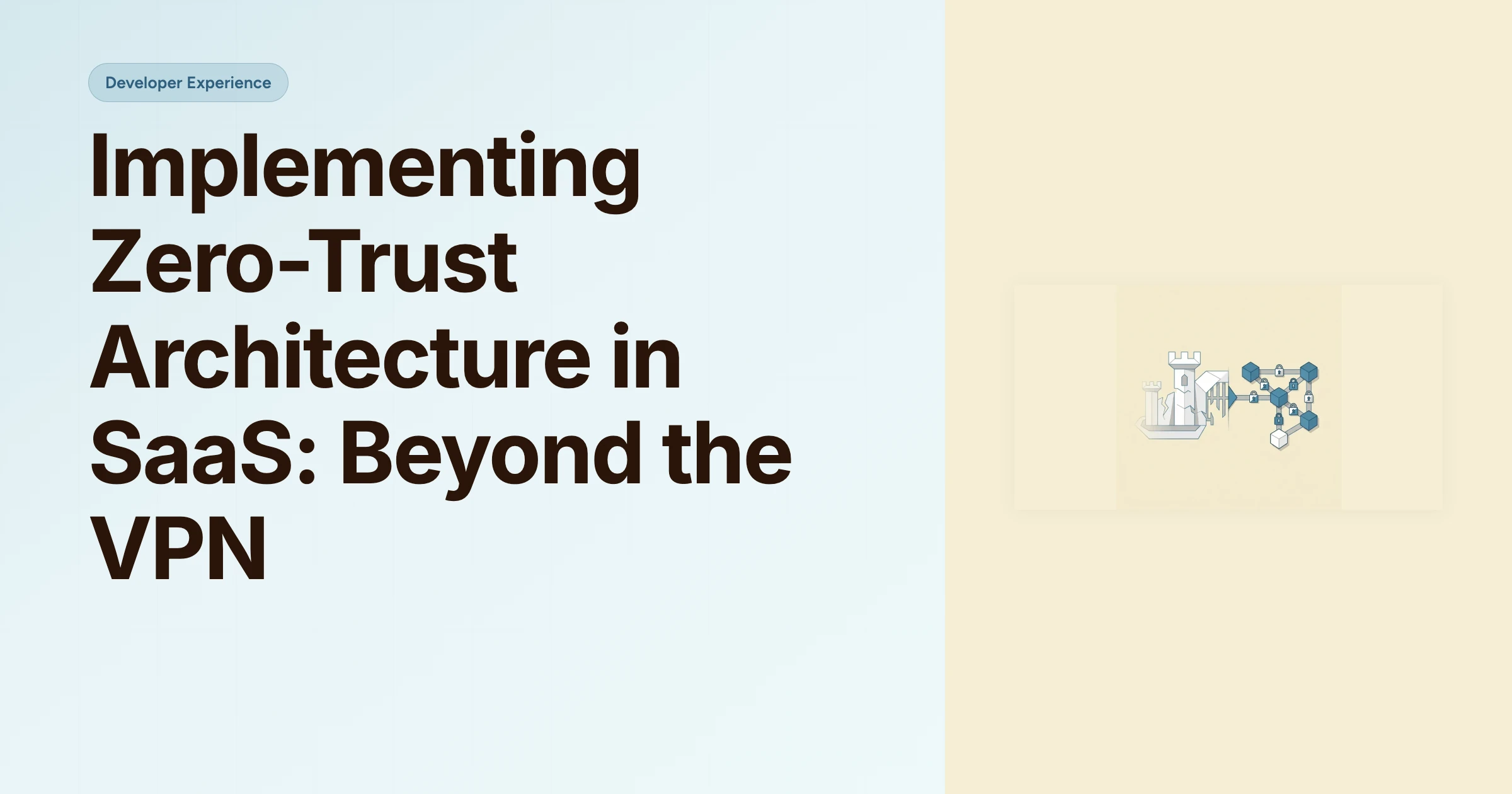
For years, the gold standard for securing SaaS infrastructure was the "Castle and Moat." You built a robust perimeter around your Virtual Private Cloud (VPC), and the VPN was the drawbridge. If a user had the key (credentials), they were let across the bridge and granted implicit trust to roam within the walls.
In 2026, this model is a liability. Your developers are on home networks, your data is distributed across AWS S3 buckets, Azure Blob storage, and Google Cloud Buckets, and your workloads are orchestrated across global Kubernetes (K8s) clusters. The "perimeter" is no longer a physical or network boundary; it is a phantom.
When you rely on a VPN, you are essentially guarding a door that no longer leads to a single room. The result is a fragmented security posture where "trusted" insiders have far more access than they require, creating a massive "blast radius" for even the simplest credential theft. For Product Managers, this represents a significant risk to customer trust; for Architects, it represents unmanageable technical debt.
The Antithesis: Why the VPN is the Primary Enabler of Modern Breaches
VPNs fail modern security requirements because they provide broad network access, lack continuous verification, and create performance bottlenecks that degrade Developer Experience (DX).
To understand why your SaaS must move toward Zero-Trust, you must first identify where traditional remote access fails. Based on research into modern breach post-mortems, we identify three specific failure points:
I. Implicit Trust and the Lateral Movement Problem
Traditional VPNs are binary: you are either "on" the network or "off" it. Once authenticated, a user often receives a private IP address within a broad subnet. If a frontend engineer logs in to debug a UI component, their session may inadvertently have network reachability to the production database. If that machine is compromised, the threat actor isn't just "on the VPN," they are "inside the moat" with a clear path to your most sensitive data.
II. Identity Blindness and Static Authorization
A VPN typically authenticates a user at the start of a session. Once the tunnel is established, that trust is rarely re-evaluated. If the user’s device posture changes, for example, if they disable their encryption, the VPN remains blind to the risk. This "once-and-done" authentication is the antithesis of modern security.
III. The "Hairpin" Performance Tax
Routing all SaaS traffic through a centralized VPN gateway creates significant latency. For global teams, this "hairpining" effect forces data to travel to a central hub before reaching the cloud resource. This leads to "shadow IT," where teams bypass security controls entirely to maintain velocity.
The Synthesis: Resource-Centric Security and NIST SP 800-207
Zero-Trust Architecture (ZTA) shifts the security boundary from the edge of the network to the edge of the individual resource, utilizing Policy Decision Points (PDPs) to evaluate context-aware risk in real-time.
Transitioning to Zero Trust means adopting a resource-centric model. According to NIST SP 800-207, the core of ZTA is the assumption that no implicit trust is granted to assets based solely on their physical or network location. Security is enforced through logical components:
- The Policy Engine (PE): The brain that decides whether to grant access based on a Trust Algorithm.
- The Policy Administrator (PA): Responsible for establishing or terminating the communication path.
- The Policy Enforcement Point (PEP): The gatekeeper (like an Identity-Aware Proxy) that intercepts requests.
The Kipling Method for Policy Design
For a "201-level" implementation, we recommend the Kipling Method (The "Who, What, When, Where, Why, and How") of access:
- Who is requesting access? (Verified via OIDC).
- What resource is being accessed? (Specific K8s pod or DB instance).
- When are they accessing it? (Enables Just-in-Time access).
- Where is the request originating? (Network health signals).
- Why do they need access? (Linked to a ticket or incident).
- How is the device secured? (Posture check via MDM).
Phased Implementation Strategy for the Big Three Clouds
A successful Zero-Trust roadmap requires equal attention to identity, device posture, and application-level proxying across AWS, Azure, and GCP.
Phase 1: Establishing the Identity Perimeter
- AWS: Leverage IAM Roles for Service Accounts (IRSA) and IAM Identity Center.
- Azure: Utilize Microsoft Entra ID and Managed Identities to eliminate hardcoded credentials.
- GCP: Deploy Workload Identity Federation for secure cross-cloud access.
Phase 2: Signal-Based Device Posture
- AWS: Integrate AWS Verified Access with your MDM to evaluate security signals. - Azure: Use Conditional Access Policies to mandate device compliance. - GCP: Implement BeyondCorp Enterprise to provide deep device-level context.
Phase 3: Deploying Identity-Aware Proxies (IAPs)
- AWS: Use Application Load Balancers (ALB) with OIDC.
- Azure: Deploy Microsoft Entra Private Access for secure remote reach.
- GCP: Utilize Google Cloud IAP to control access to apps and VMs.
High-Fidelity Documentation: The "Proof of Concept"
At Reclear, we ensure our technical guides are grounded in reality. Documentation should act as a functional blueprint, validated through rigorous testing.
Below is a high-fidelity HCL (Terraform) sample showing how a modern SaaS team can document and enforce Just-in-Time (JIT) access to production logs.
resource "aws_iam_policy" "jit_developer_logs" {
  name        = "JIT-Log-Access-Framework"

  policy = jsonencode({
    Version = "2012-10-17"
    Statement = [
      {
        Action   = ["logs:GetLogEvents", "logs:DescribeLogStreams"]
        Effect   = "Allow"
        Resource = "arn:aws:logs:us-east-1:*:log-group:/production/apps/order-service/*"
        Condition = {
          StringEquals = {
            "aws:PrincipalTag/AccessLevel": "JIT-Verified",
            "aws:PrincipalTag/ActiveIncident": "TRUE"
          }
        }
      }
    ]
  })
}
The Reclear Standard: When documenting these architectures, we include the specific CLI commands required for developers to verify the policy is active.
Why it Matters to the Board: Resilience as a Revenue Driver
Zero Trust is a business strategy that reduces the risk of catastrophic data loss, ensures compliance readiness, and accelerates product velocity.
I. Accelerated Compliance Velocity
Frameworks like SOC2 and ISO 27001 are becoming the baseline for enterprise procurement. A Zero-Trust architecture simplifies "Evidence Collection" because every request is authenticated and contextually validated.
II. Reduction in Breach Impact (Blast Radius)
For the Board, the goal is risk mitigation. ZTA contains threats at the resource level, protecting brand equity and ensuring operational resilience.
III. Improved Developer Retention and Experience
By removing the friction of manual VPN logins and providing seamless, JIT access, you improve the Developer Experience (DX), a key differentiator for engineering productivity.
Conclusion
Building a growth machine for a SaaS company requires an infrastructure (and a content strategy) that assumes the perimeter is already compromised.
At Reclear, we specialize in turning these complex architectural shifts into clear, high-conversion technical documentation. By prioritizing resource-centric security, you build a platform that your developers and your customers can trust.
Work with us
Book a call to discuss how Reclear can help document and communicate your architecture.